
What We Get Wrong About Beginnings
Paintings on Beginnings, Change, and Starting a New Year.

I always feel slightly overwhelmed as the year comes to an end, not because anything has finished, but because the calendar says it has. Explaining ourselves to time can feel useful, a superpower even, giving us the illusion we can reset time and start again. But starting over isn’t always straightforward; often we’re not getting it right.
We tend to mystify beginnings. We imagine them as clean starts, fresh pages, moments when life resets and we step forward unburdened. Sometimes this is true. Catastrophes can force a real beginning, a rupture so complete that not much of the old ways survives. But most beginnings are nothing like this. Most arrive without ceremony. They are not moments of starting over, but moments of making adjustments: a slight change of direction, a decision to continue with more focus, to repeat with intention, or to subtract what no longer belongs.
Our lives rarely move in straight, ascending lines toward revelation. More often, they take shape through effort by effort, decision by decision, until one day we ask ourselves when, exactly, this all began - and cannot pinpoint the precise moment it happened.
Since paintings can show us what words often cannot, here is my collection of how I imagine they could show the subtle ways of a life that is already in motion, at the threshold of a new year, of a new beginning.
Lucid Consent
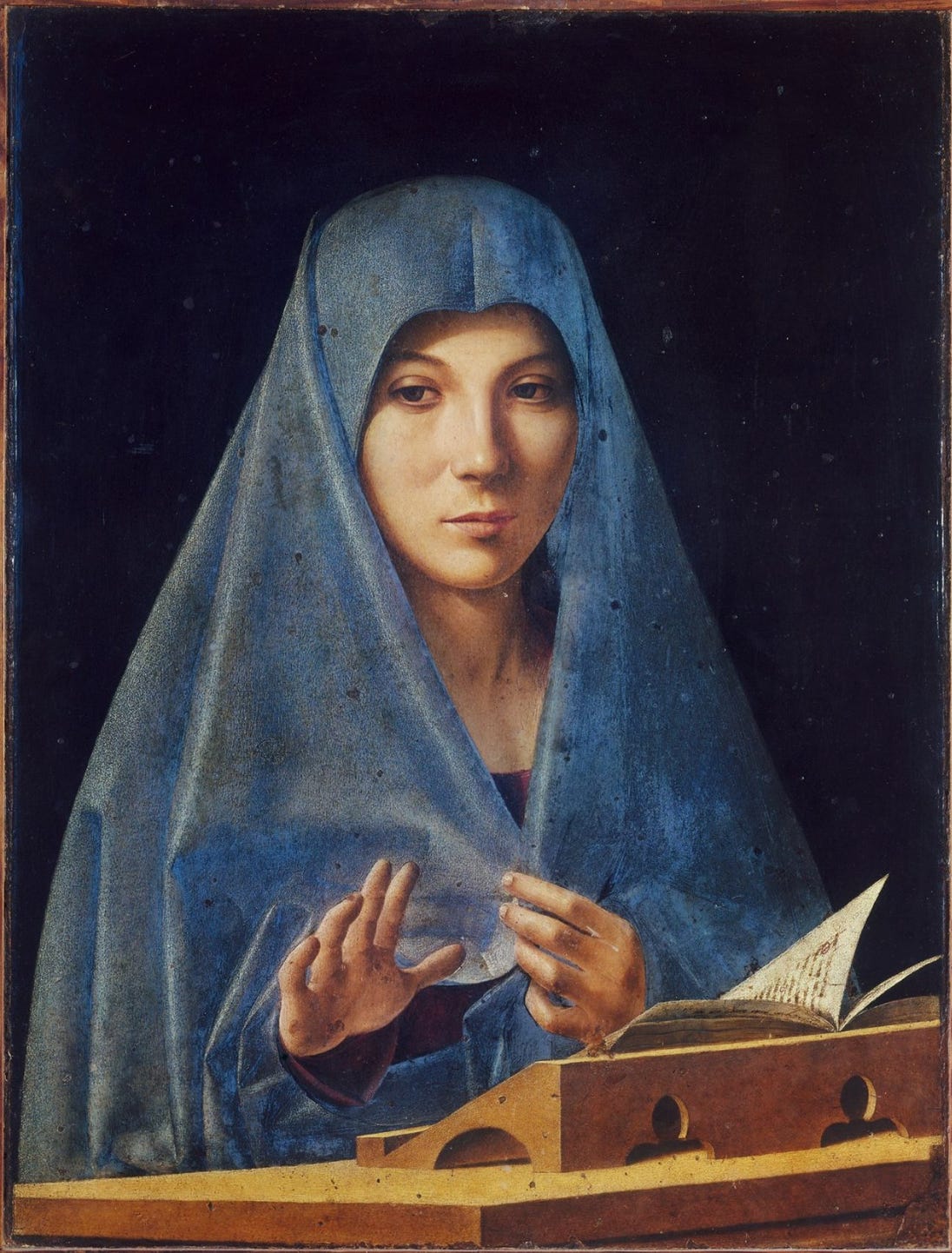
In Messina’s Virgin Annunciate - about which I’ve written a whole essay here - Mary does not leap forward or pause in awe; her gesture is measured and her gaze is lucid. This painting portrays a beginning, but it does not dramatize it. It seems more like a negotiation - a conscious agreement to move forward, aware of the consequences and hardships. The painting shows a beginning that is not about erasing the past or promising renewal, but about standing present and attentive.
Some beginnings require neither fanfare nor rupture. They start with recognizing responsibility and the conscious choice to engage with what is already at hand. Messina shows us how beginnings can be deliberate and lucid.
Deep Attention
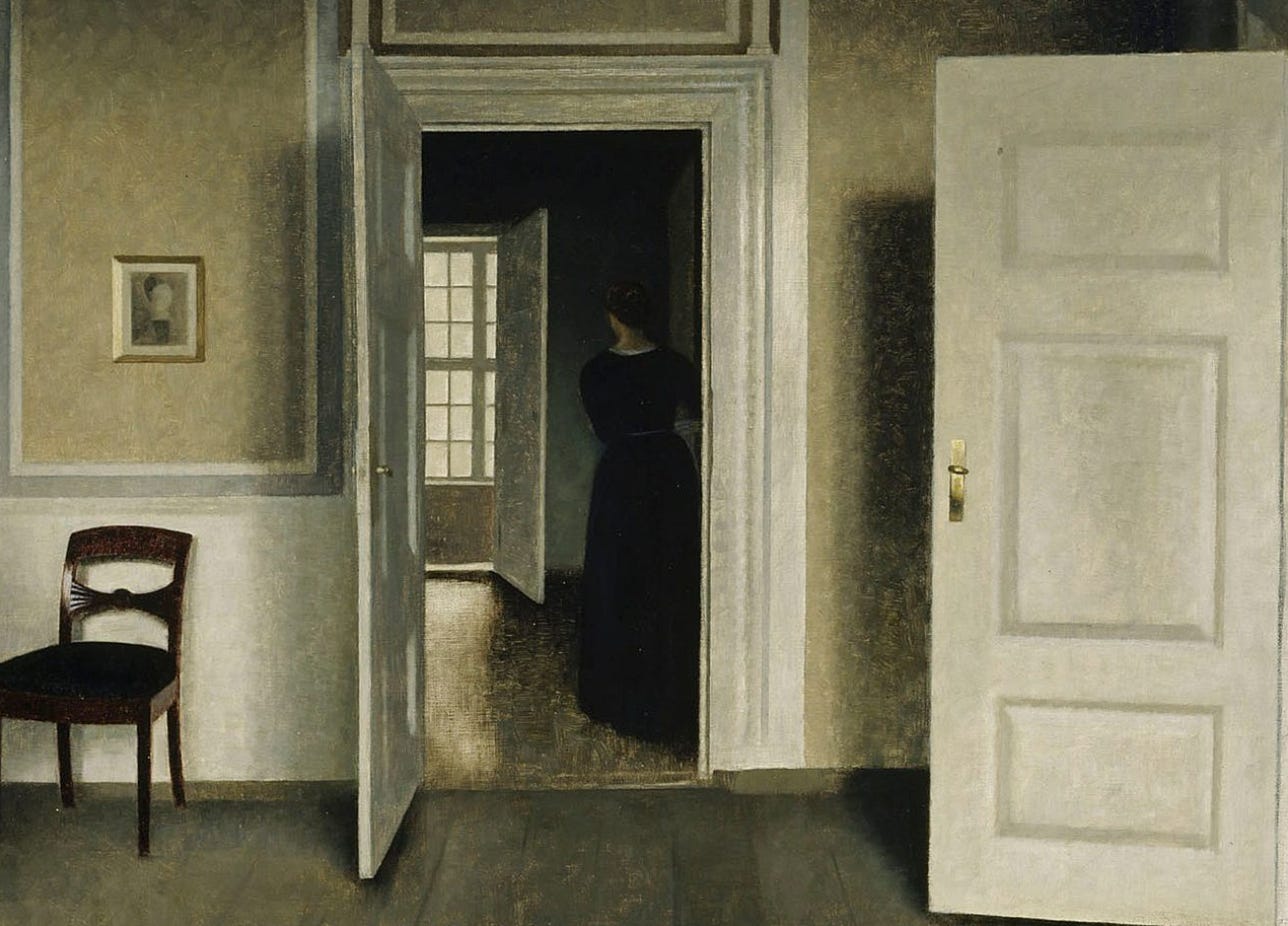
Vilhelm Hammershøi painted the same apartment again and again. Over a hundred times, he returned to the same rooms, the same doors, the same pale walls, and windows with light entering and setting quietly on the floor tiles. Nothing “begins” in these paintings in any dramatic sense. There is no event, no climax, no visible decision. And yet, the images seem to carry a heavy absence.
Hammershøi’s interiors are often described as melancholic, even sad. But this lack of movement seems to appeal to the modern viewer, who has come to appreciate it for its refusal of haste. Through a practice of deep attention and focusing on the same setting over and over, Hammershøi makes a powerful statement: the rooms are not empty - they are prepared. Doors remain open, thresholds remain unresolved. Light is not summoned; it is allowed or even expected to arrive.
We expect beginnings to declare themselves, but Hammershøi suggests another possibility: maybe some beginnings require stillness, attention, care, and staying with the same space long enough for it to change us.
Vulnerability
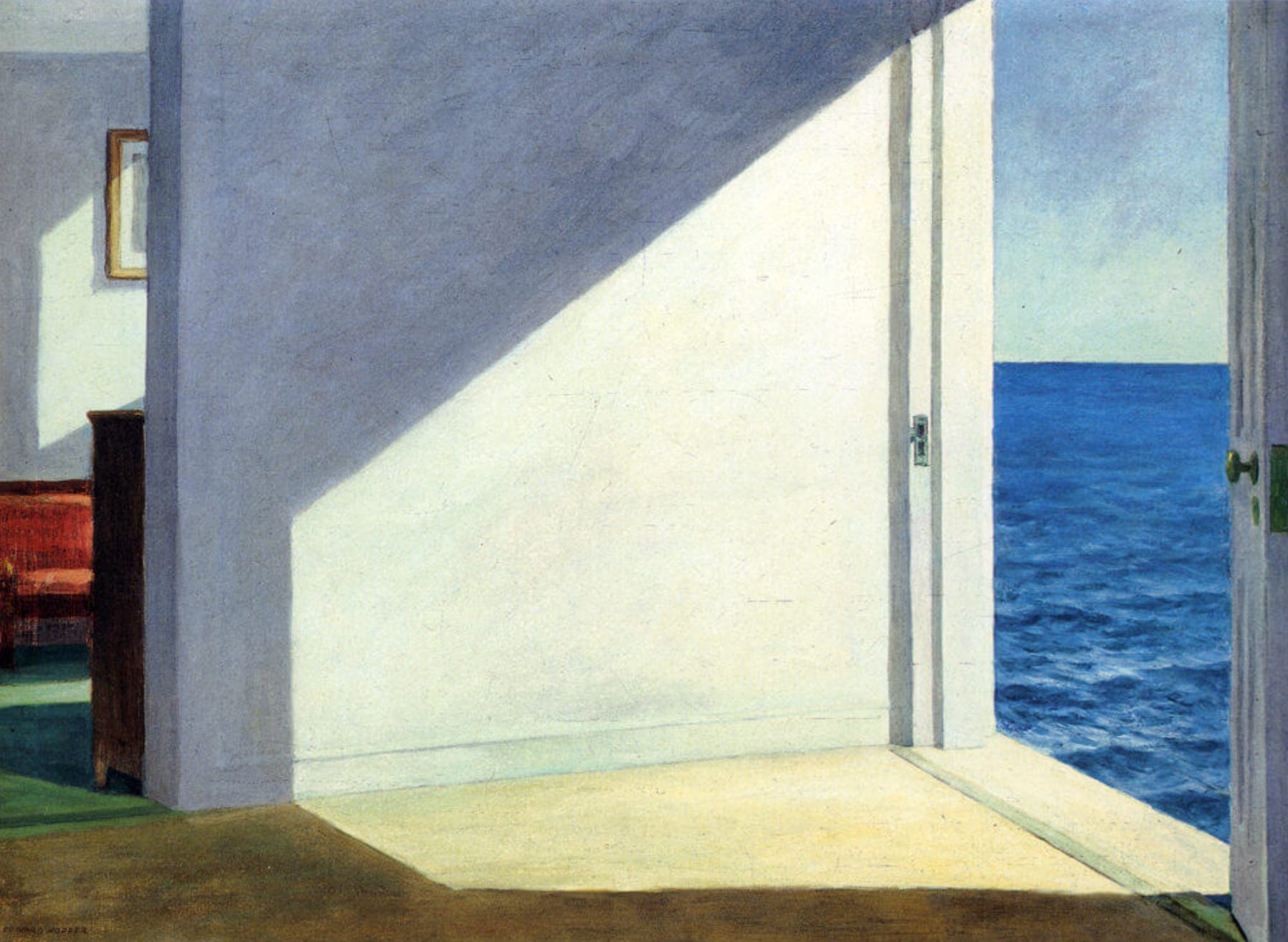
Edward Hopper’s Rooms by the Sea is often read as a painting about isolation or anxiety. A door opens directly onto the ocean, abolishing the protective boundary between interior and exterior. The scene feels dreamlike, even threatening. And yet nothing in the painting suggests panic. The apartment seems domestic and calm. The light is serene. The door stands wide open.
Hopper’s painting depicts the direct exposure to an unexpected and overwhelming view. Seen as a beginning, this is not the romantic ascent toward clarity, nor the quiet preparation of Hammershøi’s rooms. It is the sudden acceptance of vulnerability as a condition of moving forward. The future arrives without mediation, and still, the structure holds.
We often treat beginnings as moments for which we must prepare and protect ourselves before embarking. But here, Hopper suggests the opposite: some beginnings might ask of us to proceed without protection, allowing what lies ahead to enter fully, even at the risk of being unsettled by it.
The Leap
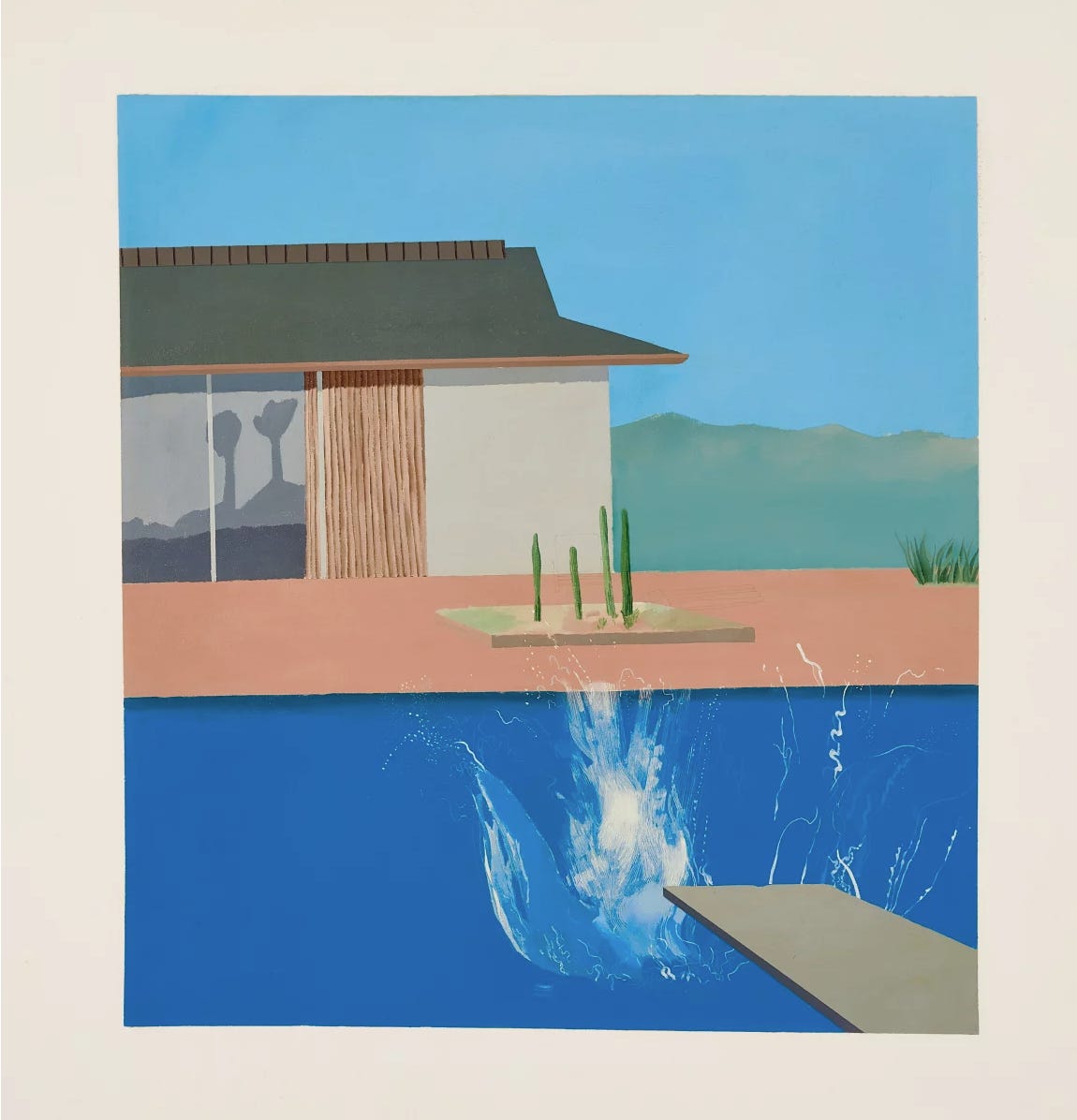
David Hockney’s The Splash depicts joy, youth, or Californian lightness. But structurally, it is a painting about a choice that was already made. The diver is already gone. What remains is the consequence of his leap: water suspended mid-air, a clean modernist house, a pool that will soon return to stillness. The world has not reorganized itself around the act. It has merely registered it.
Hockney was drawn to California because it promised excitation - visual, bodily, sexual. “No doubt it had something to do with sex”, he admitted. The leap, in this sense, is not calculated. It is propelled by desire. And desire does not wait for certainty.
The outcome is not known, but still, you leap because the alternative - staying at the edge - has become intolerable. The erotic charge of The Splash lies in this surrender: the moment when commitment overtakes deliberation.
Beginnings like this do not unfold gradually. They happen as an instant of rupture. Meaning comes later, if it comes at all. Hockney paints the instant after choice, when the future has already been entered, is irreversible, and the only thing left to do is to live with its consequences.
Some beginnings are not about planning or foresight. They are about action and consequence, and the courage to embrace the unknown.
If this essay stayed with you, buying me a coffee is a simple way to support my work.
Deliberate Practice
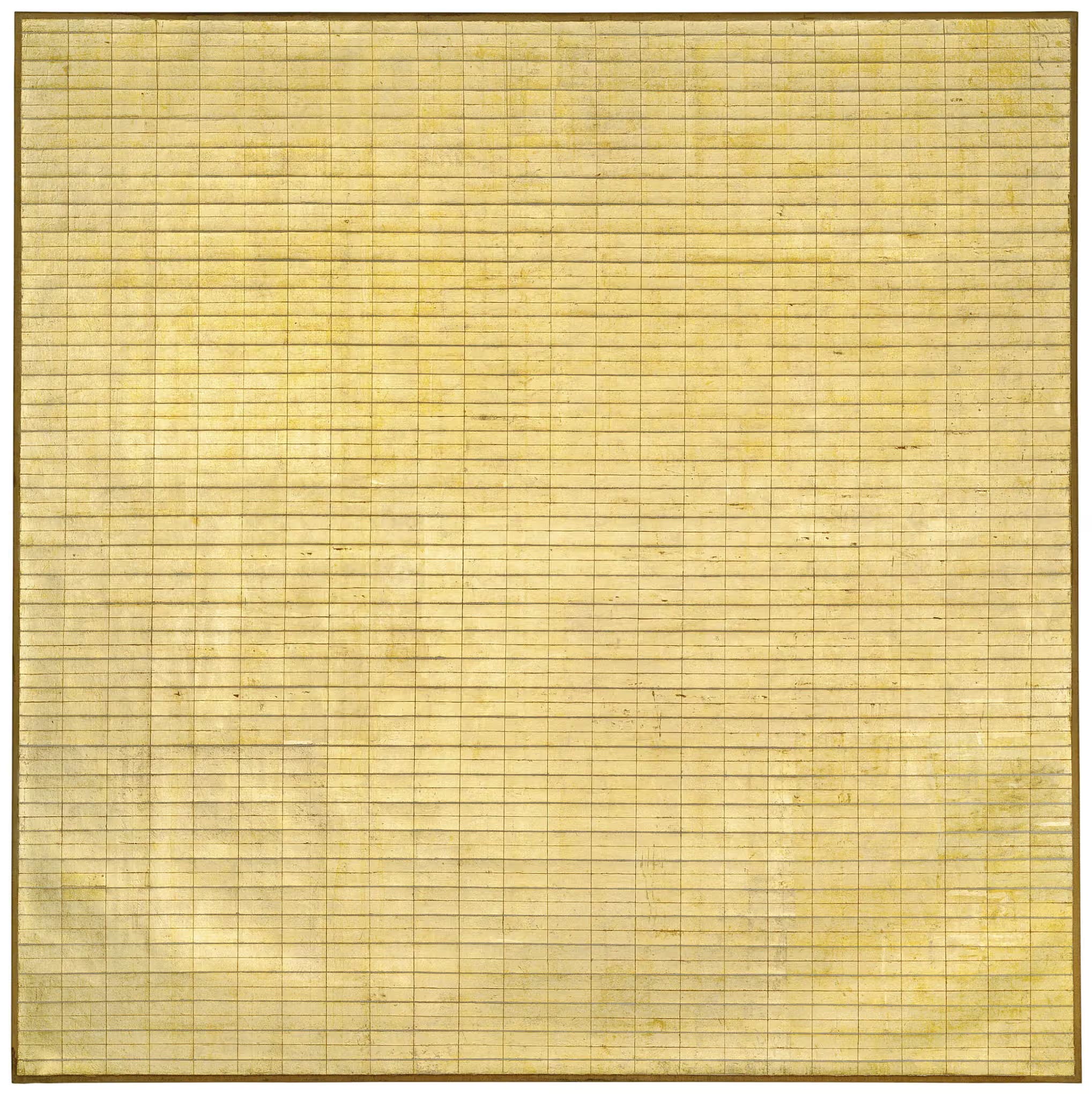
Agnes Martin's paintings do not announce a start. They refuse drama, rupture, and revelation. A grid appears, faint and restrained, and then it appears again. The line returns to itself without escalation, without narrative.
This is often mistaken for rationalism. But Martin was more concerned with emotional clarity. Sustained focus gave her stability. Each line is placed with attention, repeated not to advance, but to remain aligned. Nothing here promises transformation. Nothing claims progress.
Some beginnings do not feel like beginnings. They are choices to continue deliberately, with discipline and care. Sustained repetition becomes orientation. It steadies the self, allowing something internal to settle.
This is precisely what makes the work so instructive about beginnings. Agnes Martin’s works show endurance. A beginning, in her terms, is not an event. It is a practice.
If you want to keep reading, you can subscribe to receive new essays in your inbox.
Simplicity
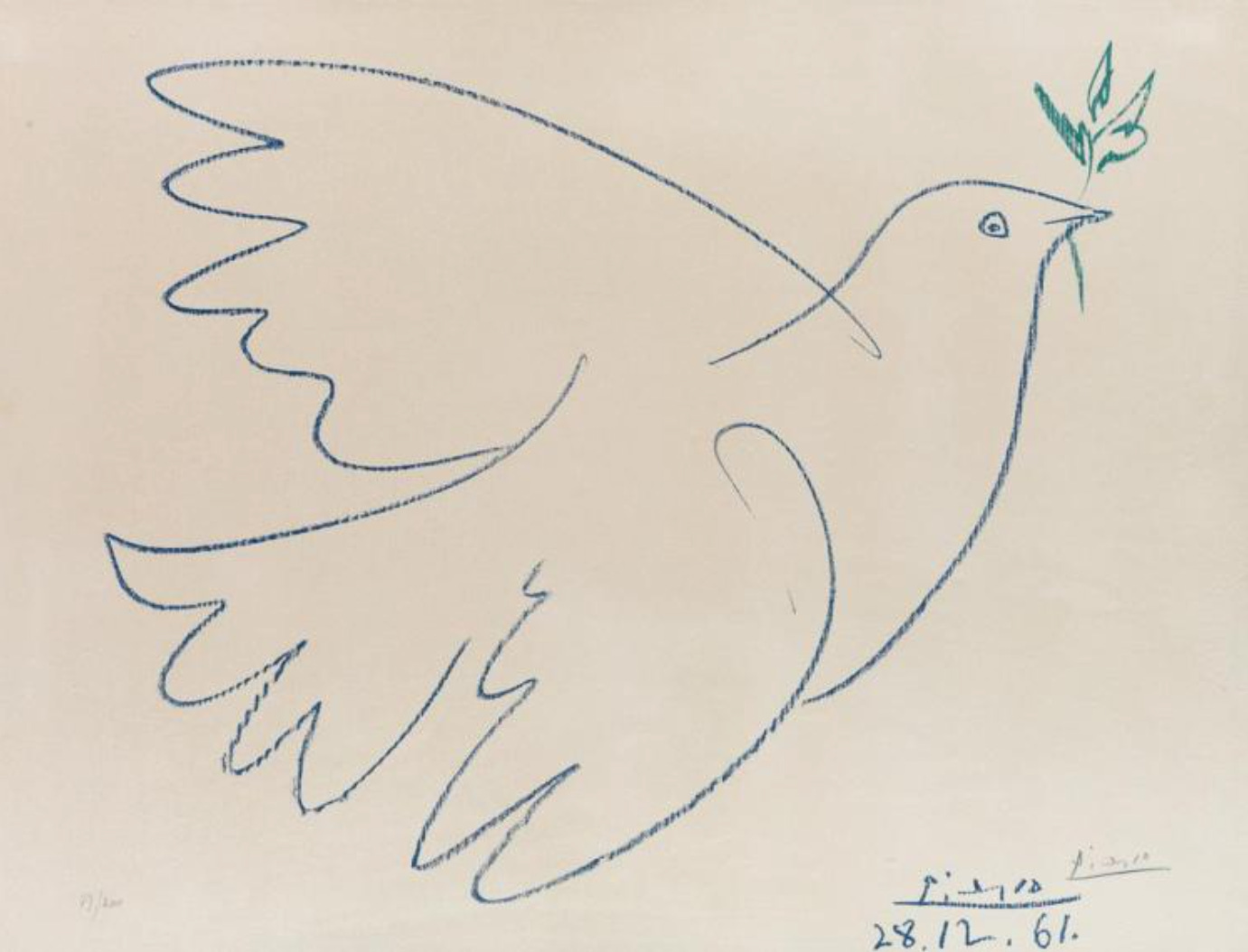
Pablo Picasso’s dove is often seen as a symbol of hope, but it does not soar. It does not move forward. It simply exists, a simple flat sketch held together by a line fragile enough to disappear with one correction.
After witnessing wars and catastrophes, Picasso does not imagine a better world. He reduces the world to something that can still be drawn.
Beginnings are not always about adding, progressing, or envisioning. Sometimes they are about subtraction - deciding what can be left behind, what no longer holds, what is unnecessary. The dove is not a promise; it’s restraint, trying to break things down and reduce them to what really matters, to what’s essential.
Beginnings often mislead us into imagining linear progression: that life has a clear start, a peak, and forward momentum. Most paths do not work this way. Life is accumulated, often invisible, and only later can we recognize the points where one decision, one act of attention, or one leap altered the course.
And perhaps this is the only truth about beginnings: they are rarely the dramatic thresholds we imagine. We like to picture life as a path with a clear start, a peak, and a direction forward - as if standing high enough will grant perspective and clarity. But in reality, beginnings are often subtle, cumulative, and opaque. We rarely see the full landscape, and the future does not always unfold neatly before us. Like a figure on a foggy mountaintop, we may feel oriented, yet much remains hidden, and our view of the path is partial at best. Most of us do not start over. We stand where we are - and see what still holds.
If this piece resonated, feel free to share it with someone standing at the edge of a new beginning. Here’s to beginnings that don’t announce themselves. Happy New Year!