
What a 15th-Century Painting Can Teach Us About Motherhood
A small Renaissance portrait that made me rethink choice, responsibility, and motherhood.

Two years ago, in early autumn, my partner and I went to Sicily. The trip felt both overdue and perfectly timed - a celebration, a pause, and, without us naming it, a quiet threshold.
It had been a year since he told me he wanted a child.
That moment marked the beginning of a new kind of dialogue between us - one that unfolded over coffee, long walks, and small domestic moments. We spent that year testing each other’s theories on parenting, values, and childhood; debating discipline and tenderness, independence and safety, the balance between guiding and letting be. Every new topic seemed to lead back to the same implied question: What kind of parents would we be?
We didn’t realize it then, but those endless conversations were our way of preparing. Not for the logistics of having a child, but for the gravity of the choice itself.
The Human Scale
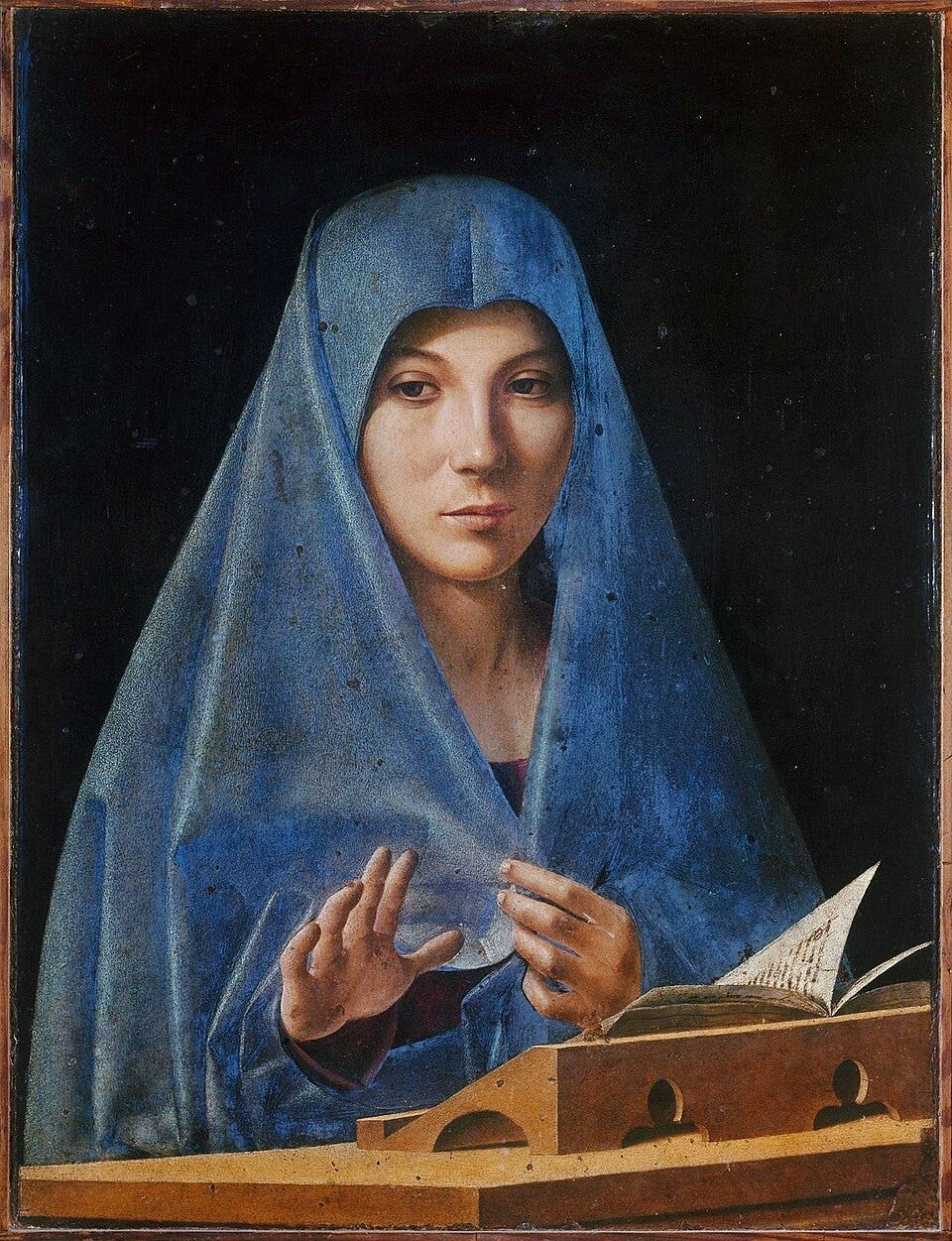
That sense of gravity hit me unexpectedly in Palermo, standing before The Annunciation by Antonello da Messina.
At the Palazzo Abatellis, which houses the Galleria Regionale della Sicilia, we moved from one religious painting to another - works I had learned to appreciate for their beauty and for how they translated the Bible into visual language in centuries when many could not read. They were luminous and reverent, but to me, a little distant. Room after room of Madonnas with Child, Madonnas Nursing (Madonna Lactans), angels descending, lilies, blue robes, and the serene and untouchable face of Mary in the Annunciations - those centuries-old depictions of the Virgin Mary receiving the message that she would bear the Son of God. The iconography repeated itself. They all spoke the same language.
Except one. Antonello da Messina’s Virgin Annunciate.
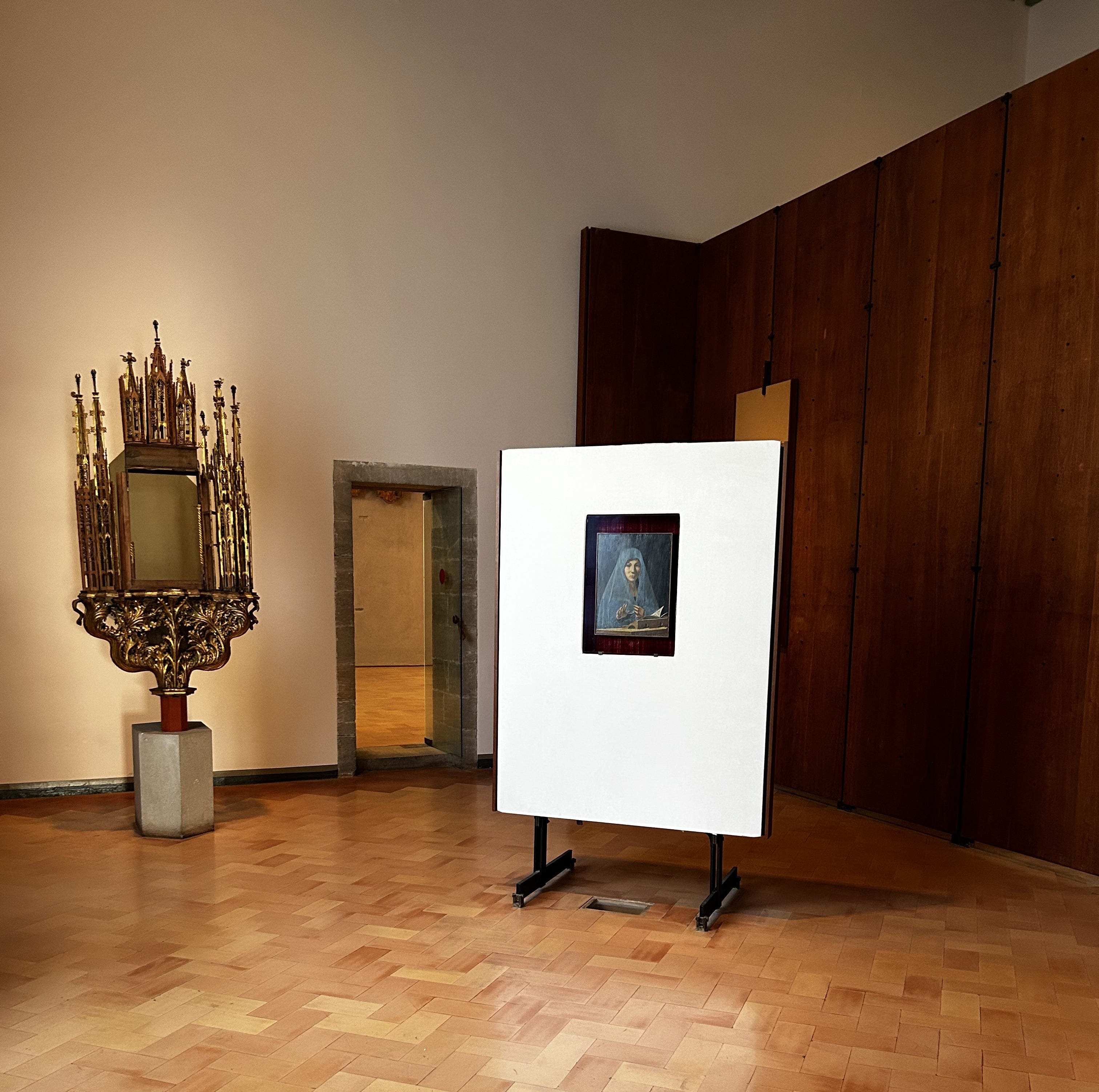
After seeing the painting reproduced on museum banners, you don’t expect it to be this small. The scale itself brings the subject closer, almost private.
The painting’s style, although rooted in the Italian Renaissance tradition, exhibits a strong influence of Flemish portraiture, evident in the three-quarter view of Mary and the dark background—both of which draw our attention to her inner world and the psychological depth of the scene.
Mary sits at a desk, interrupted mid-thought. No angel. No golden light. The divine messenger is off-canvas. Nothing like the theatrical Gothic masterpiece with the same subject painted a century earlier by Simone Martini and Lippo Memmi. Nor like Fra Angelico’s Annunciation, painted around the same time — luminous, serene, celestial.
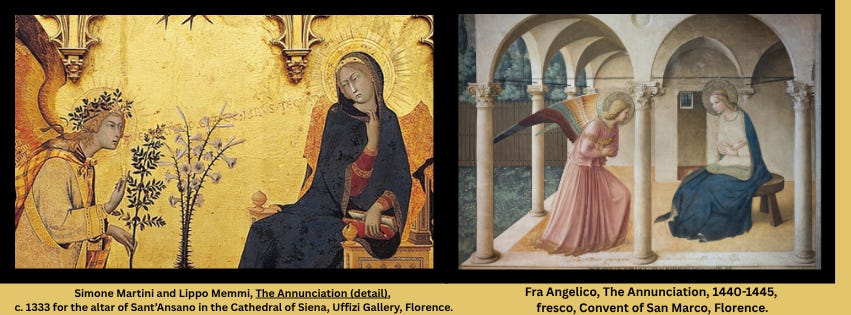
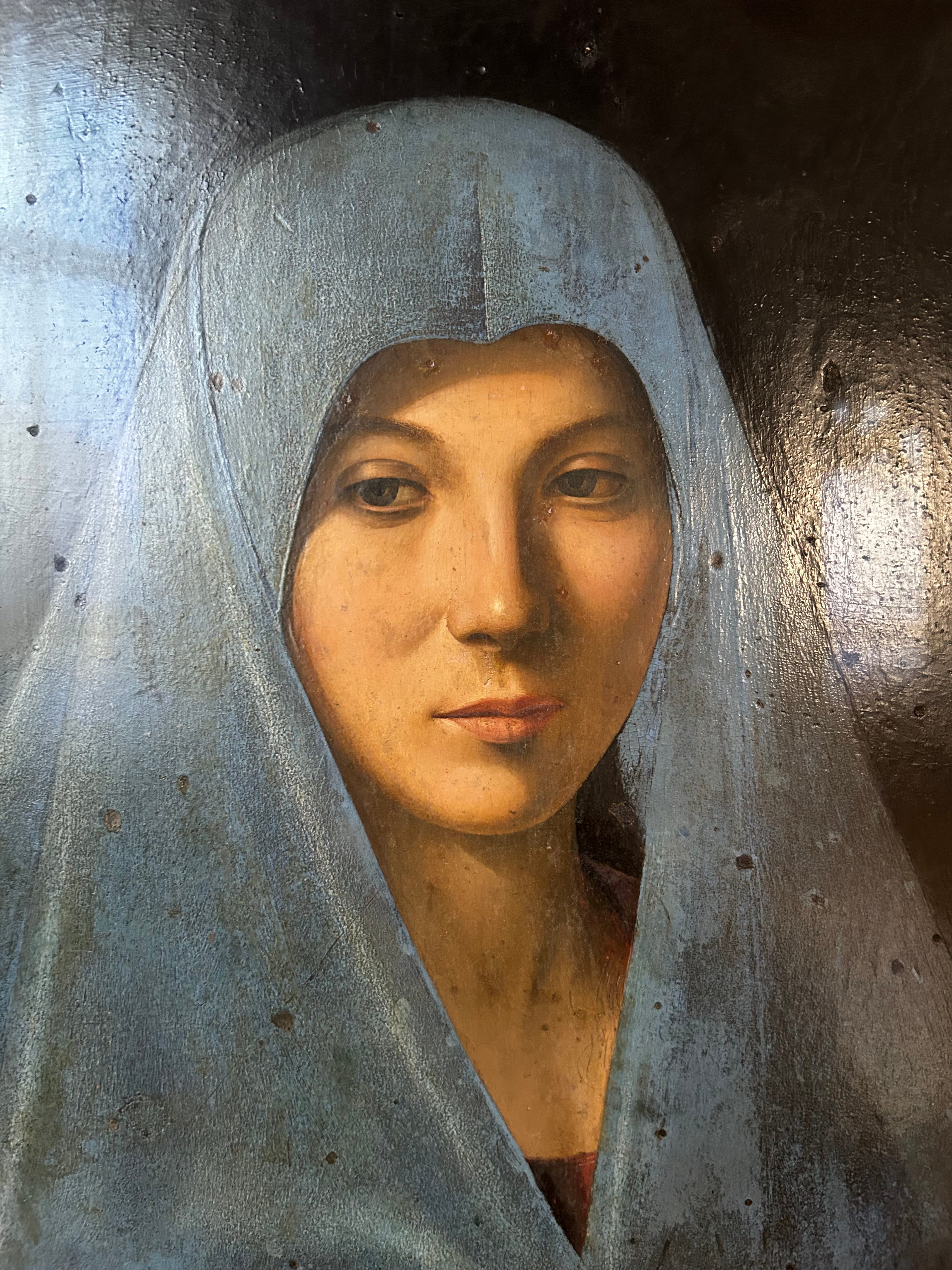
Unlike these earlier works, which remain faithful to the traditional iconography of the Annunciation, Messina strips the scene of its symbols. It disposes of all the iconographical elements and shows us an almost secular portrait of Mary - deeply moving and psychologically honest. Her eyes, wide yet controlled, look directly at us. She is neither ecstatic nor submissive. She is interrupted in her reading. Startled. Grounded. Human. Only her hand, half raised—a gesture that might mean stop, wait, or give me a moment.
For the first time, I saw Mary not as a symbol, but as a woman realizing — with clarity rather than awe — what she was being asked to become.
Not divine acceptance, but sober understanding.
Not destiny, but decision.
It wasn’t a depiction of a miracle. It was a portrait of responsibility.
If you’d like to support my work, you can buy me a coffee. It helps me keep writing with time and focus.
The detail that reveals
The writer Leonardo Sciascia noticed a detail in Messina’s painting that deepened my understanding of it: the veil Mary wears is carefully ironed, folded, and taken out, as one would a treasured garment, on solemn occasions. Sciascia saw in it “the bodily awareness of maternity, of certainty.”
“The spectator should notice the deep fold at the center of the forehead. While it was just a pictorial detail for the painter, to us it tells of an article of clothing that has been carefully kept in the chest together with other treasured things. This mantle is taken out on special occasions, on solemn festivities. Notice the marvelous contrast between the right hand suspended in a solemn gesture and the other hand that is making a gesture quite usual to a peasant woman: she is folding the edges of the mantle. Look at the mysterious smile, the gaze full of the bodily awareness of maternity, of certainty […]”.
That detail - the fold of fabric, the ordinary grace of preparation - speaks to the humility before an event we cannot control but can only receive with reverence, awe, and grace.
Thinking about Choice
That image stayed with me long after we left the museum. I kept thinking about how rarely we talk about motherhood as a decision in that sense: a conscious, trembling step into the unknown.
So much of the conversation is about timing: when the career is stable, the relationship is strong, and the fear subsides. But none of those conditions ever fully align. For years, I postponed the thought, afraid of losing freedom, of closing a door that would not reopen.
The truth is, you can’t prepare for motherhood. You can only prepare yourself to be awake to it—to say yes, fully aware that it will rebuild you in ways you can’t predict.
What remains
Now, a year after our son was born, those early conversations still echo between us - not as theories anymore, but as small, daily negotiations of love and a lot of patience.
The stress of early parenthood cannot be overstated. You can imagine it, read about it, even prepare for it - but you only truly understand it once you live it. People tend to mystify having children, to wrap the idea of parenthood in romance or destiny, but the truth is, it is - and rightfully so - a very calculated decision. Children are neurologically fragile; they cannot regulate their emotions at a time when you are also flooded with your own. And you are responsible for that tiny person - completely and forever.
When that awareness is missing, a chasm can open between reality and expectation, one that can turn into exhaustion or even depression. It can strain the couple, too, if they are not aligned in what they expect and what they’re ready to give. But when both see clearly what they’ve chosen, it becomes a force for enormous growth: for the couple, for the individuals, for the child, and for the family taking shape around them.
Messina’s Annunciation opened a conversation that keeps unfolding in me and reminded me that the most meaningful choices rarely begin with certainty. They begin with awareness - that moment of suspension before we act, when we sense that something vast is about to enter our lives.
That young woman, startled and sober, is still somewhere inside me. The one who looked at the horizon of motherhood and realized it wasn’t only about having a child, but about becoming someone new.
And perhaps that is what art does at its best: in a museum somewhere, in front of a quiet painting, it lets you witness your own becoming. It asks you to look, and in looking, to see yourself more clearly.
If this piece resonated - if you’ve ever faced a decision that felt both terrifying and deeply right - consider subscribing or sharing it. Each week, I write about creativity, motherhood, and the invisible thresholds that change us.