

Christmas has become the season when “slowing down” is most loudly performed - through candles, handmade decorations, and carefully staged rituals of simplicity. At the same time, many of us arrive here exhausted, overwhelmed, and secretly convinced that rest is something we must first earn. This essay is not about slow living as an ideal, but about what it feels like when slowness becomes something we long for but cannot reach - and why a candle, of all things, briefly helped me stop without calling myself a failure.
1. What happens if you stop?
I feel like I need to start by making a confession. I am not “slow” at most things. I usually pride myself on being efficient, on taking a direct route to delivering clear and fast results. In my professional life, this was a skill. In my personal life, it is sometimes a burden. In sports, it often gets me injured. Even when I swim, my coach asks me to slow down and focus and I’m convinced that if I do, I might drown.
One of the hardest question I’ve ever faced - the kind that makes your mind go blank - is what do you think will happen if you stop?
Even now I don’t have an answer to this.
So to be clear: I am not your slow-living guru. I don’t know how to stop.
And yet - on the 23rd of December - I gave myself a gift and went to a candle-making workshop.
Not because I urgently needed candles. Who does? Not because I’m particularly interested in mastering wax temperatures or perfect wicks. But because candles suggest something modern life rarely allows: a slow burn. Time that does not rush. Heat that accumulates patiently. And most of all, a kinder kind of light.
Christmas Day feels like the right moment to talk about this. Not in terms of slow living as a lifestyle brand, not about aesthetics or moral superiority - and let's be honest - Instagram is full of this guilt-inducing trend - but about the exhaustion that makes slowness feel almost unreachable.
2. Making a list, checking it twice.
I recently told my mother what my days feel like as a new mother. The pressure I feel - to be deeply present for my child, to stay professionally sharp through online courses, to remain fit and active, to write, to create, to tend to a household, to feed everyone, to clean, to keep up.
She listened, and then she said something that surprised me: It was never like this for me.
And she was right. This is not to say her days were not heavy. They were. But they were not split into a thousand competing selves. No one asked her to be fulfilled, productive, efficient, fit, and serene all at once.
Every time my baby falls asleep, I run to the next task. When someone else watches him, I use the time to be productive. There is no wasted moment. There is no room for idleness.
And then, this question comes to mind again: what do you think will happen if you stop? What would happen if I were to simply sit and indulge in something that does not add value?
I would probably feel like a failure.
If a friend told me this, I would hug them and say, It’s okay. You’re allowed to just sit.
But I cannot offer myself the same mercy.
When I left the hospital with my newborn, everyone repeated the same advice: Sleep when he sleeps. It felt like something a General would advise you before throwing you into the trenches. I didn’t listen. That would just mean being soft.
But last week, I felt like I couldn’t keep up with myself. Everything slowed - not by choice, but by necessity. I couldn’t run as much. I couldn’t do all the things I wanted to do. And instead of fighting it, I tried something unfamiliar: permission.
The effect was immediate and profound: first of all, the quality of my time with my son changed. I could look him in the eyes when he mumbled something and not mentally race through essays unwritten, kilometers unrunned, dishes uncooked, gingerbread unbaked, decorations unmade - the invisible checklist ticking endlessly in my head.
I could just look at him as he raised his eyebrows with wonder and showed me a small rock, as if it were the most fascinating formation on Earth.
And if you let go of everything else, it is fascinating, simply because he finds it fascinating. But mostly because it’s something you are seeing together.
Because meaning, sometimes, is nothing more than shared attention.
3. A Simpler Life
I recently read a passage in A Simpler Life - a School of Life book that found its way to me at the right moment. It said that taste has a compensatory dimension:
“The taste of an era or a society reveals what people want more of but don’t actually feel they securely possess (…). We crave simplicity not because we are simple, but because we are drowning in complexity.”
Earlier epochs didn’t glorify simplicity because there was no need to. A simple life - meaning few possessions, plain food, early nights, time outdoors - was the norm. Today, simplicity plays the role that splendour once did at Versailles. It is what we long for, precisely because we no longer have it within easy reach.
This is why my mother couldn’t fully recognize my sorrow. This is why my inner monologue sounds like Santa Claus - always making a list, always checking it twice.
This is also why scrolling past perfect Christmas kitchens and trad-wife rituals on Instagram gets under my skin. Not because I believe in them, but because part of me wants to. I watch women making paper decorations, baking bread from scratch, lighting candles at noon - and my body reacts before my mind does. I know it’s an aesthetic, a performance of simplicity staged for an algorithm. And still, something in me leans closer to the screen, thinking: maybe if I did this right, everything would quiet down.
And yet - despite knowing all this, despite knowing how badly I resist stopping - I still signed up for a candle workshop. Because I needed a reason to stop without calling it failure.
If you’d like to support my work, you can buy me a mulled wine - something warm and spicy, meant to be savored.
4. The Source of Light
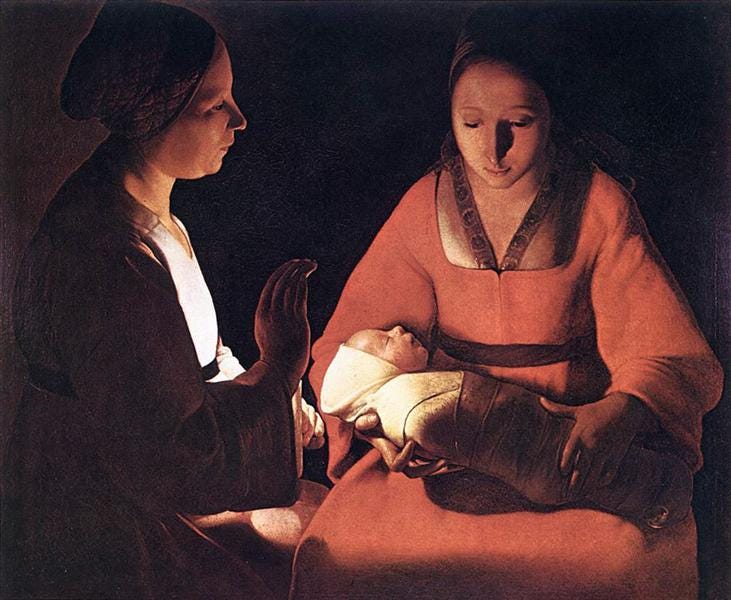
I’m drawn to this painting because light doesn’t arrive from outside, as something dramatic that breaks in. Illumination comes from within the frame, fragile and insufficient, yet enough. Like the delicate light of a candle. Created during the Baroque era - a time drawn to movement, spectacle, and emotional excess - The Newborn refuses drama. This Nativity scene is almost secular in its restraint. The faces are calm, inward, unperformative. The miracle is not announced; it is held.
This light matters to me because this year I don’t want my path lit by what others display, recommend, or perform. I want to learn how to walk with the light I already carry - even if it’s small, imperfect, or flickering.
I think this is what drew me to candle-making. I wasn’t looking for slowness as an achievement, or rest as a reward, or presence as another thing to excel at - but permission to burn slowly.
Candles burn at their own pace - or not at all.
Crafting candles means stepping briefly outside electricity, notifications, and urgency - into something almost atemporal.
They teach us that one moment can be enough. That a small light does not need to improve itself to matter.
Wherever this finds you - in noise or quiet, fullness or lack - I wish you a moment that doesn’t ask anything of you. Merry Christmas.