
Living Curiously: Lessons from Rick Rubin’s The Creative Act
A reflection on Rick Rubin’s The Creative Act and how art isn’t what you make — it’s how you live.

As I previously shared here, my life has often felt like a collection of passions and interests spread across domains that seemed contradictory: art, business operations, cooking, writing, sports, and, more recently, motherhood. Sometimes, this diversity left me feeling confused and a few steps behind the version of myself I imagined I should be.
And then I read Rick Rubin’s The Creative Act and something inside me loosened. His words made me see that what I had been calling “fragmentation” was, in fact, a pattern.
So, what holds it all together? What’s the common denominator between analyzing a Renaissance painting, cooking dinner, and architecting a business pivot?
The answer for me, I’ve come to believe, lies in approaching everything with curiosity and openness, what Rick Rubin calls “noticing”. The same pull that makes me arrange flowers just so, linger over a line in a book, research a new foreign dish to cook for dinner, or swim for three hours in a lake. It isn’t about productivity or mastery. It’s about a way of seeing and engaging with the world. This is what Rick Rubin, the legendary music producer, so beautifully articulates in his book The Creative Act: A Way of Being.
Curiosity as a Way of Being
Rubin’s career itself is a testament to this approach. He has spent decades transforming creative raw energy into something that has touched many, from shaping hip-hop in the 1980s to being a creative force across genres and producing for Johnny Cash, the Red Hot Chili Peppers, and Kanye West. His genius lies in deep attention—in listening. Rubin argues that creativity isn’t a specialized skill reserved for painters, composers, or poets — it’s a way of being, a mindful engagement with the world.
He suggests that the source of creation is “a subtle vibration, a quiet pull, an intuitive knowing.”
For me, it’s the curiosity about creating meaning that led me to study art. It is also approaching things with the same curiosity that keeps your senses open, that propelled me from academia into the boardroom, seeing a company as a living, complex, and organic organism for which you have to find the most effective and elegant structure for growth. And it is the same quiet inquiry now, in the—usually—tender chaos of early motherhood: that makes me ask myself “What does it mean to build a home that feels like an authentic expression of who we are as individuals and as a family?”
If you’d like to support my work, you can buy me a coffee. It helps me keep writing with time and focus.
If we accept Rubin’s premise, then suddenly, the scattered pieces of our lives snap into alignment. We begin to see that we are all artists — and that self-discovery is curatorial. Studying whatever draws your curiosity, learning a new skill, reading a book — these are not distractions from your career or your family life; they are the active selection of materials for the grand exhibit that is your own self.
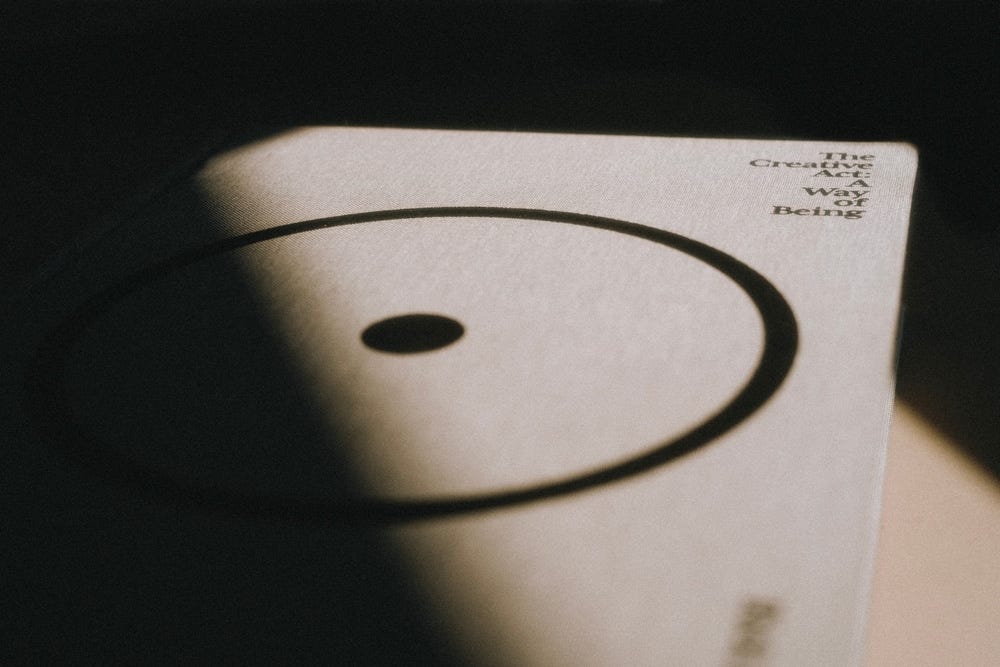
Reading The Creative Act itself is part of the experience. The hardcover design is minimalist, clean, and tactile, mirroring the clarity and openness Rubin encourages in the creative practice. What Rick Rubin illustrates in his text, he also illustrates in creating this book-object, where the alchemical sun symbol is used throughout as a break symbol, and the title and text fonts were hand-picked by the author himself.
The Creative Act is remarkably easy to read: composed of short, self-contained chapters, written in plain, unpretentious language that moves and inspires through its simplicity and precision, immersing the reader into the creative experience and process as a true spiritual practice. To be honest, this was one of the rare books that hit closer to my spirituality, while seeming to be a sort of a spirituality guidebook.
Here are the core ideas that resonated most with me:
Creativity is universal—a birthright, a fundamental aspect of being human.
The artist is a vessel, a unique filter through which universal ideas take tangible form.
Free play, curiosity, and non-judgmental experimentation—a “beginner’s mind”—are the surest ways to avoid the paralyzing pressure of perfectionism.
Focus on process, not outcome: success lies in full engagement and completion, not in fame, sales, or praise.
The creative life is a “practice of paying attention.” It asks us to heighten our sensitivity to the world, reduce distractions, and trust our intuition.
The Responsibility to Live as an Artist
Reading The Creative Act took the pressure off creating. It reminded me that the point isn’t to produce something remarkable, but to live in a way that allows beauty to appear. It made me feel responsible — not for making art, but for living as an artist.
It brought back something my high school literature teacher once said. She told us she didn’t want to make good students out of us, but good human beings. That if life led us to sweep the streets, we should bring something of ourselves when doing it. And if we were to build chairs, we should build them as if God himself would sit on them.
Ultimately, that’s what Rick Rubin is saying too: that whatever life asks of us, our task remains the same — to bring attention, care, and beauty into the world, in whatever form we can.
If this way of seeing speaks to you, you might like what comes next. Subscribe to follow the thread.