
A monster, certainly, but normal.
On Art, Identity, and the Beauty of the Mixed, Monstrous and ever-changing self.

Last week, I visited NOCA – New Oradea Contemporary Art, a newly built-from-the-ground-up space dedicated to contemporary art in my hometown. It opened with an exhibition called Sphinx, Beast and Girl; Unicorn, Chimera and the Mixed Body, curated by Suzana Vasilescu and Cristina Vasilescu.
The exhibition featured works by Apparatus 22, Ion Țuculescu, Ecaterina Vrana, Márta Jakobovits, Vioara Bara, Ștefan Bertalan, Michele Bressan, Alex Bodea, Ana Botezatu, Rudolf Bone, Christian Jankowski, Ciprian Mureșan, and Miron Schmückle.
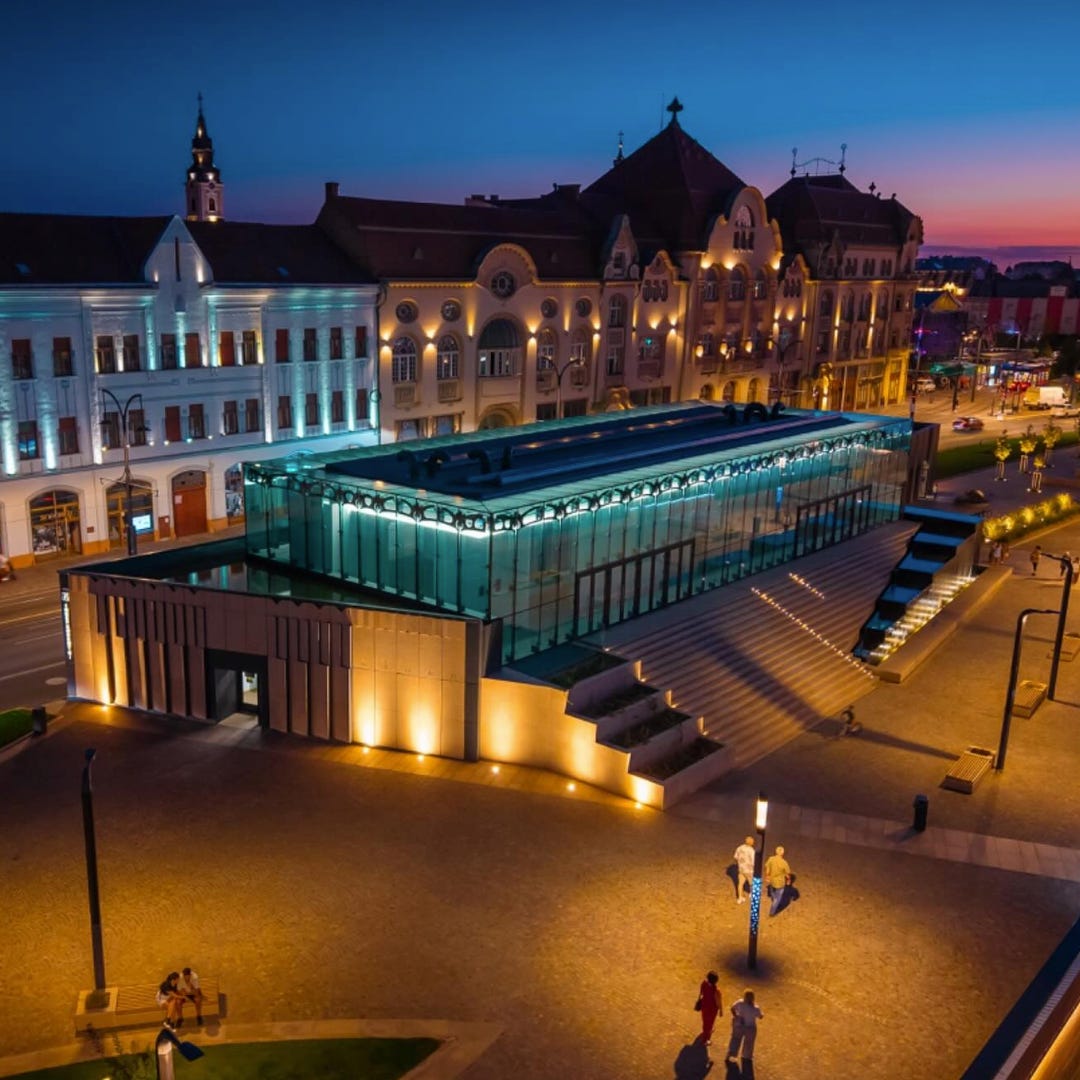
I left the place fueled with ideas, energy, and optimism — and deeply grateful for the people who made this possible, for the grit and courage it must have taken to advocate for such a space in Oradea, a small Art Nouveau city on the western border of Romania in Transylvania. A city where history and architecture are ever-present, but where contemporary art rarely found a home. Until now.
The exhibition’s theme felt both ancient and startlingly current. The curators began with a line from philosopher Michel Serres:
“Monster? A sphinx, beast and girl; centaur, man and horse; unicorn, chimera, composite and mixed body. Where and how to locate the place of suture or mixture, the crack where the bond is knotted and tightened, the scars where the lips, right and left, above and below - but also angel and beast, the vain, modest or vengeful victor and the humble or repulsive victim, the inert and the living, the miserable and the very rich, the complete idiot and the lively madman, the genius and the imbecile, the master and the slave, the emperor and the clown - are united? A monster, certainly, but normal. What shadow must be removed now to reveal the meeting point?”
A monster, certainly, but normal.
Such a strange sentence - one that hints at the contradictions that shape us all. The exhibition, gathering a constellation of artistic voices, looks at the monstrous not as something to fear but as a form of transformation, ambiguity, and potential.
The monster, the chimera, the hybrid body - they all resist purity and perfection. They remind us that identity, like history, is made of sutures and scars. In a region marked by shifting borders and mixed languages and religions, this feels particularly true. The “mixed body” becomes not an aberration but a mirror: a portrait of who we are, and how we survive change.
The Monster as a Mirror
The line - “A monster, certainly, but normal” - stayed with me long after I left the exhibition. Not only because it speaks of mythological bodies, about the ways we explain concepts to children, about the way we help them make sense of the world, but also because it speaks of the body I inhabit now.
In the last two years, my own identity has shifted and stretched in ways I could not have anticipated. I went from being entirely defined by my professional life, to being swallowed - joyfully, bewilderingly - by motherhood, and now I stand again at a threshold, preparing to return - a return full of conflicting feelings, as I suspect it is for all mothers - to a world that once felt like my core.
If a monster is a being made of mixtures and sutures, of contradictions and new limbs stitched onto an old form… then perhaps motherhood is one of the most monstrous experiences of all - and one of the most normal.
It’s no wonder that certain works in the exhibition struck me with an unusual force.
Márta Jakobovits: A Pilgrimage in Clay
I remember a moment two years ago in October, leaving my office late on a Friday evening, during a high-stakes work project. My body felt tight and rigid, and my mind was completely overwhelmed with the work agenda and deadlines. I felt pressed into a shape that had no softness left. Everything was serious. No room for joy or laughter. Curiosity or play seemed frivolous.
And then, in the small park near the parking lot, as I was heading for my car, I saw a woman - bohemian, unhurried - collecting leaves and chestnuts. She looked about my age. I assumed she might be preparing an activity with her children.
I envied the spaciousness she seemed to allow herself. The simple pleasure of touching the world without KPIs, without urgency, or productive value extraction.
Márta Jakobovits’ installation - stretched on the whole length of the exhibit hall, placed lower, closer to the floor - carries that same spaciousness - the quiet dignity of someone who collects the world like a child: leaves, pebbles, pine cones, pieces of existence. I remembered the pleasure I felt when I still did this on vacations.
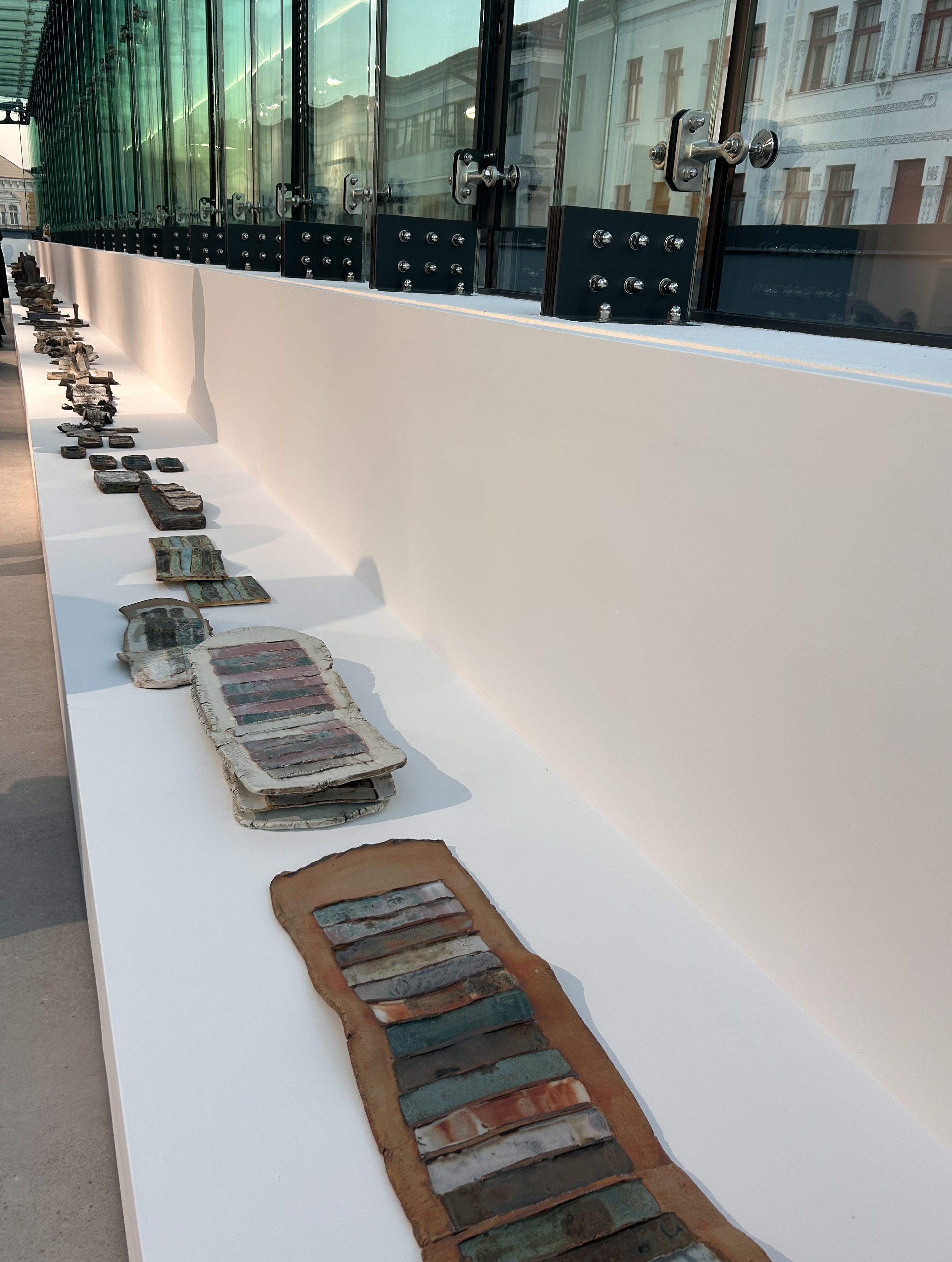
Starting with a ceramic Jacob’s ladder, connecting the skies to earth, her installation invited me to walk alongside it, slowly, as if I too could return to that humble path of curiosity and attention. It felt at once ancient and child-like - raw clay forms, textured surfaces, natural dyes, and organic shapes that seemed to grow from curiosity itself.
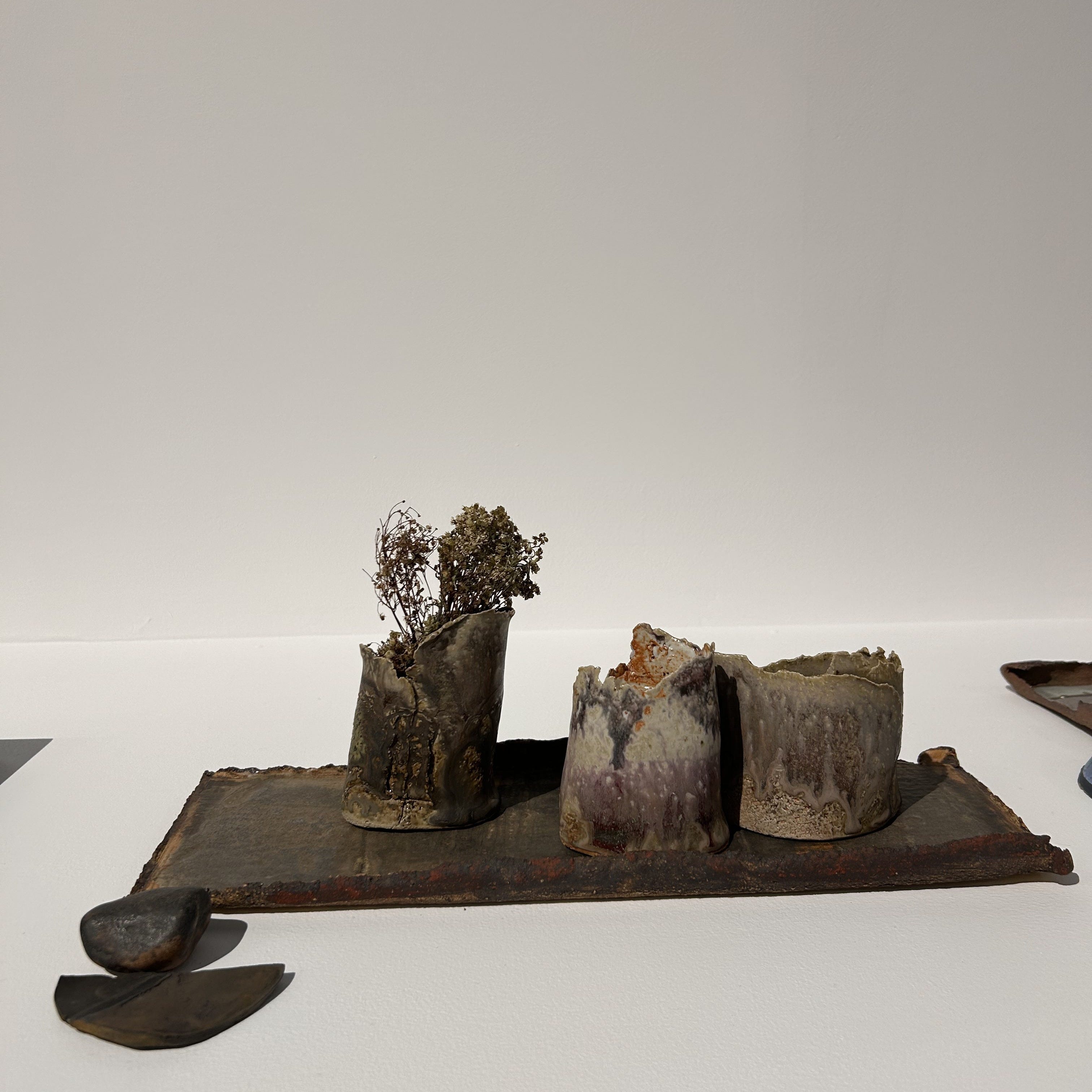
Her words, which I later found in an interview, illuminated everything I felt standing there:
“There is a constant dialogue with the nature around me. I am driven by a strong curiosity – I carry out endless research on materials and glazes, using different techniques, processing possibilities and allowing the results to generate new forms, new ideas.”
“The revelation that inner forces deeply influence the identity of a form was a key moment for me. When I create forms, whether they are human-like or abstract shapes, I feel it is essential to approach these forces with respect and humility. This respect allows me to discover their role in defining the form’s identity.”1
Her work is a spiritual, slow, humble, tactile pilgrimage where the invisible becomes visible.
Ecaterina Vrana and the Art of Reinventing Yourself
Then there was Ecaterina Vrana, whose works I discovered only now. Her self-portraits - thickly painted mermaid, or her face emerging from a pink wig on golden canvas - showed a woman refusing to be defined solely by the life she lived externally, and instead crafting a new inner identity, again and again, through paint.
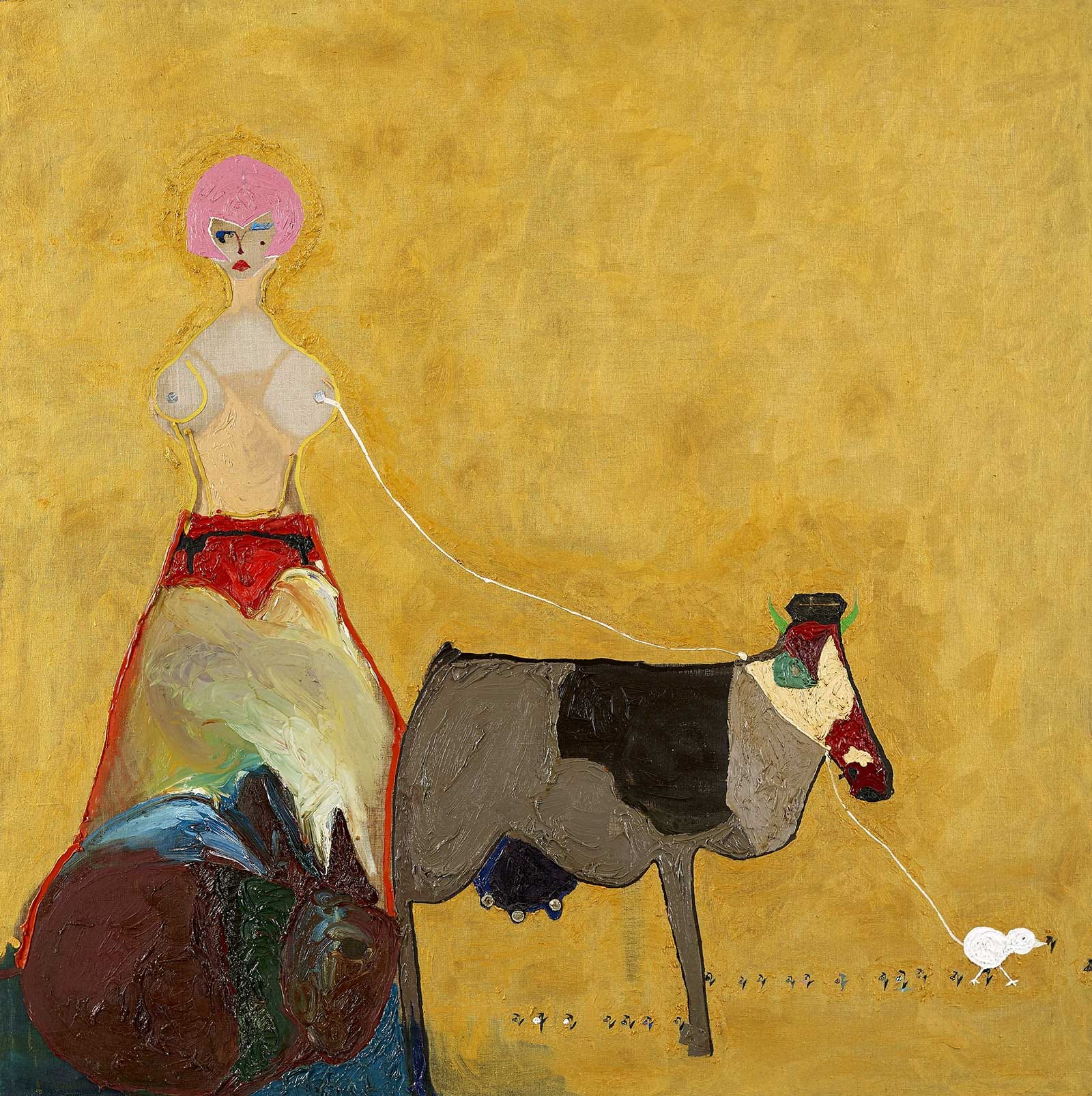
Her paintings made me think of the ways we all rebuild ourselves. How we invent new faces for the seasons of our life, and how sometimes we need to do this in order to survive, or go through difficult times.
There was something profoundly tender in the way she portrayed herself - candid, humorous, vulnerable, deeply subjective.
A reminder that identity is not given; it is made.
If you’d like to support my work, you can buy me a coffee. It helps me keep writing with time and focus.
Other Voices, Other Monsters
Other works circled this idea in different ways:
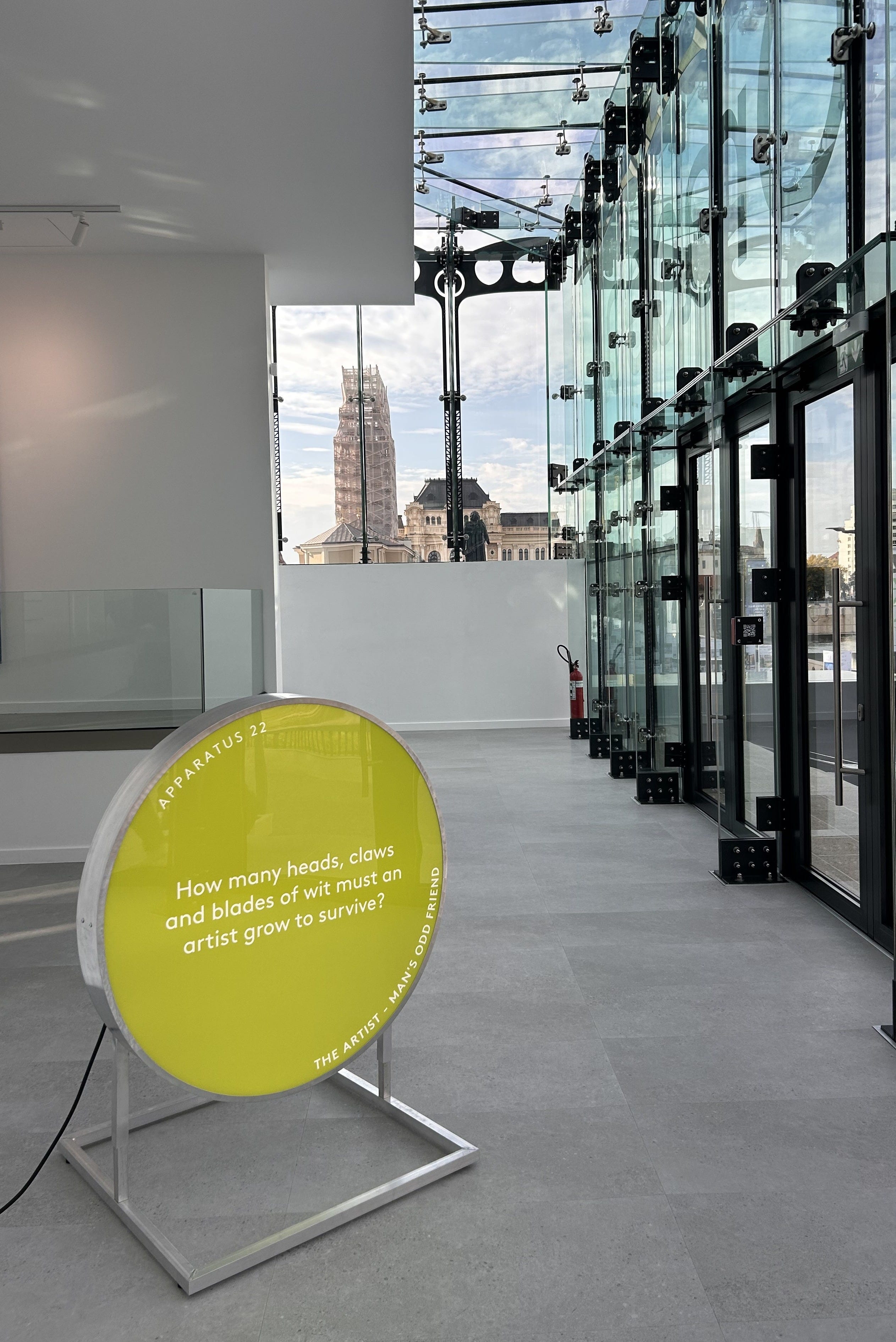
Apparatus 22, with their glowing LED questions — “How many heads, claws and blades of wit must an artist grow to survive?” - a strange and sharp reminder of what it costs to be an artist, regarded as an outsider, an eccentric, in a world that prefers clean lines and easy categories.
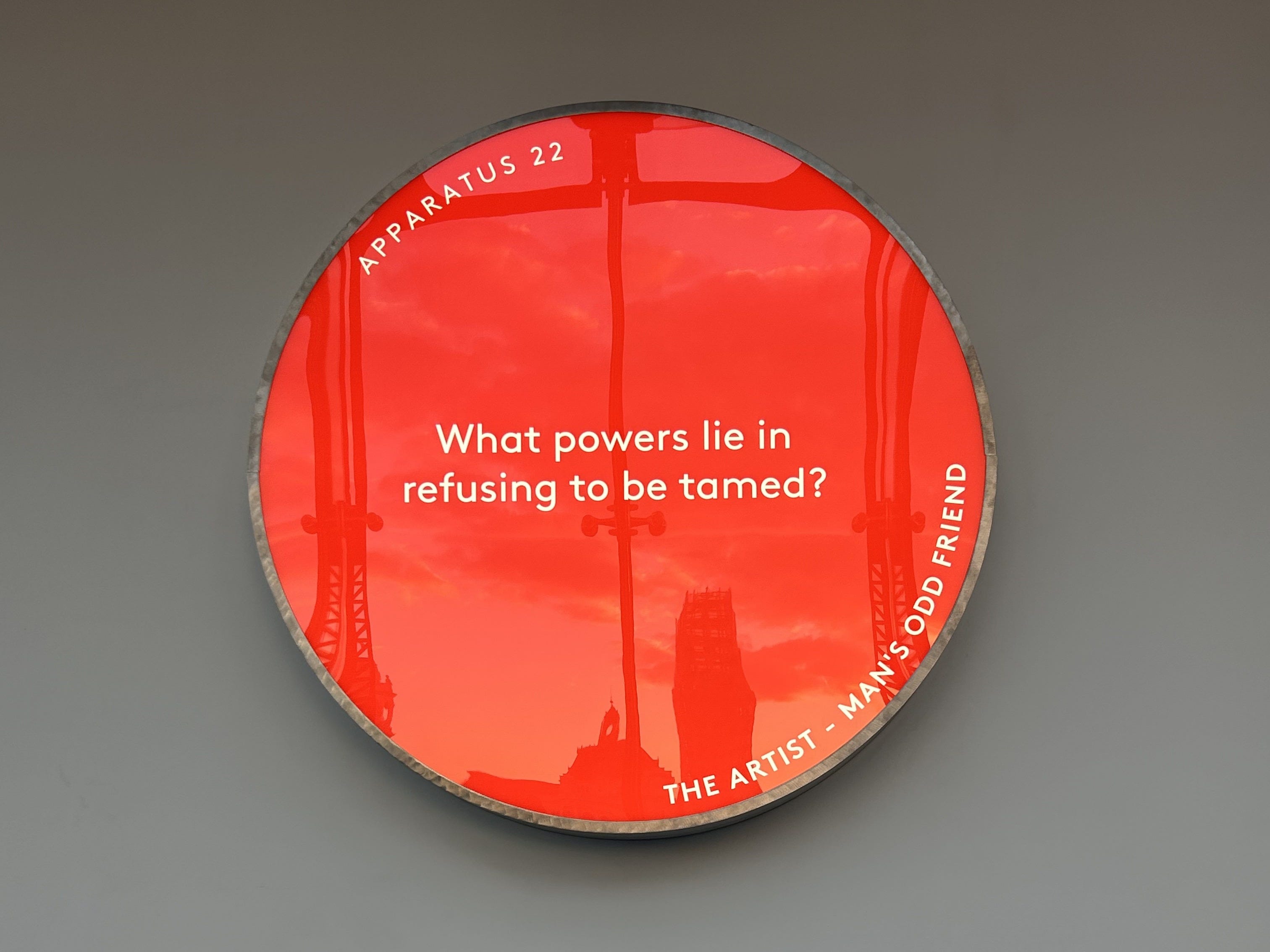
Or their LED installation “What powers lie in refusing to be tamed?”, which shows another way of speaking about the monstrous, the wild, the part of us that refuses to be domesticated. Both installations are humorously signed: “The Artist - Man’s Odd Friend”.
All of these works circle the same idea: that the monstrous is not the grotesque. The monstrous simply shows the parts of ourselves that don’t fit neatly anywhere, but insist on being seen. It is the mixed, the hybrid, the body going through a major transformation, the body in the process of becoming.
When You Think You Don’t Understand Contemporary Art
Still, I know how people often feel when they enter a space like this. Contemporary art can be intimidating. “I don’t get it,” someone says quite apologetically - as if art were a test and they had failed.
To those people, I would say that, in my view, contemporary art is not always made to be understood - at least not immediately. It’s meant to be experienced. It invites you to pause, to ask questions, to let your imagination do some of the work.
When I visit exhibitions like this, I try to borrow the perspective of a child and look at the art works with curiosity and with no preconceived ideas or expectations.
A Gentle Guide to Looking at Contemporary Art
1. Sit with the work. Literally, if you can.
Give it time. Let the first impression pass; the second is almost always better. Revisit them on other occasions if you can.
2. Notice your reaction — even if it’s confusion.
Confusion is not failure. It’s the beginning of thinking. Own it and investigate further.
3. Ask the simple questions.
What does this remind me of?
What feeling does it stir?
What memory does it bring forth?
Art becomes alive in these small moments.
4. Don’t rush to “get it.”
Nobody understands the curatorial text in one go. Truly - nobody.
5. Drop your guard. Let the senses lead.
Meaning often comes through the body before it reaches the mind.
6. Think of it like spending time with a child.
Don’t push.
Don’t measure.
Just stay present, curious, patient.
Some works are mirrors. Some are doors.
7. Let yourself play.
Some works are toys for the mind.
Let your thoughts stretch and twist like clay in your hands. Absorb as much color, form, and feeling as you can.
You’re allowed to enjoy it, to laugh, to be puzzled. Because the most important thing is not to take yourself too seriously.
8. You don’t have to resonate with everything.
You only have to be awake to the moment.
Do all this and the art will meet you halfway.
I don’t pretend to resonate with every work I see. But I always leave with a renewed sense of wonder - and a reminder that art’s role is not to give answers, but to help us ask better questions or even to help us feel the things we often only rationalize.
Why We Need Spaces Like NOCA
This is why the opening of NOCA mattered to me.
It brought this form of questioning, imagining, and expanding closer to home. It created a space in Oradea where you can be surprised, challenged, or energized - and where conversations about who we are and who we might become can finally happen.
Spaces like this one invite us to look again at ourselves, our history, and our imagination. They build bridges between local lives and global questions. They connect Oradea - our small, elegant, layered city - to a larger conversation about the world.
If you ever walk into an exhibition and feel lost, stay a little longer.
Sit down. Look again.
You don’t need to know. You only need to feel.
Sometimes, seeing begins where understanding ends.
If you enjoyed this reflection, keep the conversation going by sharing this piece.
Or consider subscribing to The Red Thread — a space for curiosity, art, and the art of attention.
https://www.artway.eu/posts/giving-identity-to-forms---an-interview-with-marta-jakobovits